Kaekai — Citizen complaint
management system
Concept project
Portfolio case study
A platform that connects citizens directly to government agencies — from reporting a local problem, to tracking progress, to closure by the responsible department
Pain points identified
What we
discovered
Citizens lacked a clear channel to report issues, and had no way of knowing whether anything was being done. On the government side, staff received complaints through multiple disconnected channels — creating duplication and making follow-up nearly impossible.

Citizens didn't know who to call or where to file, leaving many issues
unresolved indefinitely.

Cases lost between departments
Without automated routing, staff forwarded cases manually via Line or phone — prone to error and delay.

No visibility into where a complaint stood, who was handling it, or when it
would be resolved.
How we solved it
Features designed
to fix each problem
We designed Kaekai around a central routing model — every complaint goes through one government body first, then gets dispatched to the right department. Citizens can track their case at any point, with or without an account.
One place to file any complaint
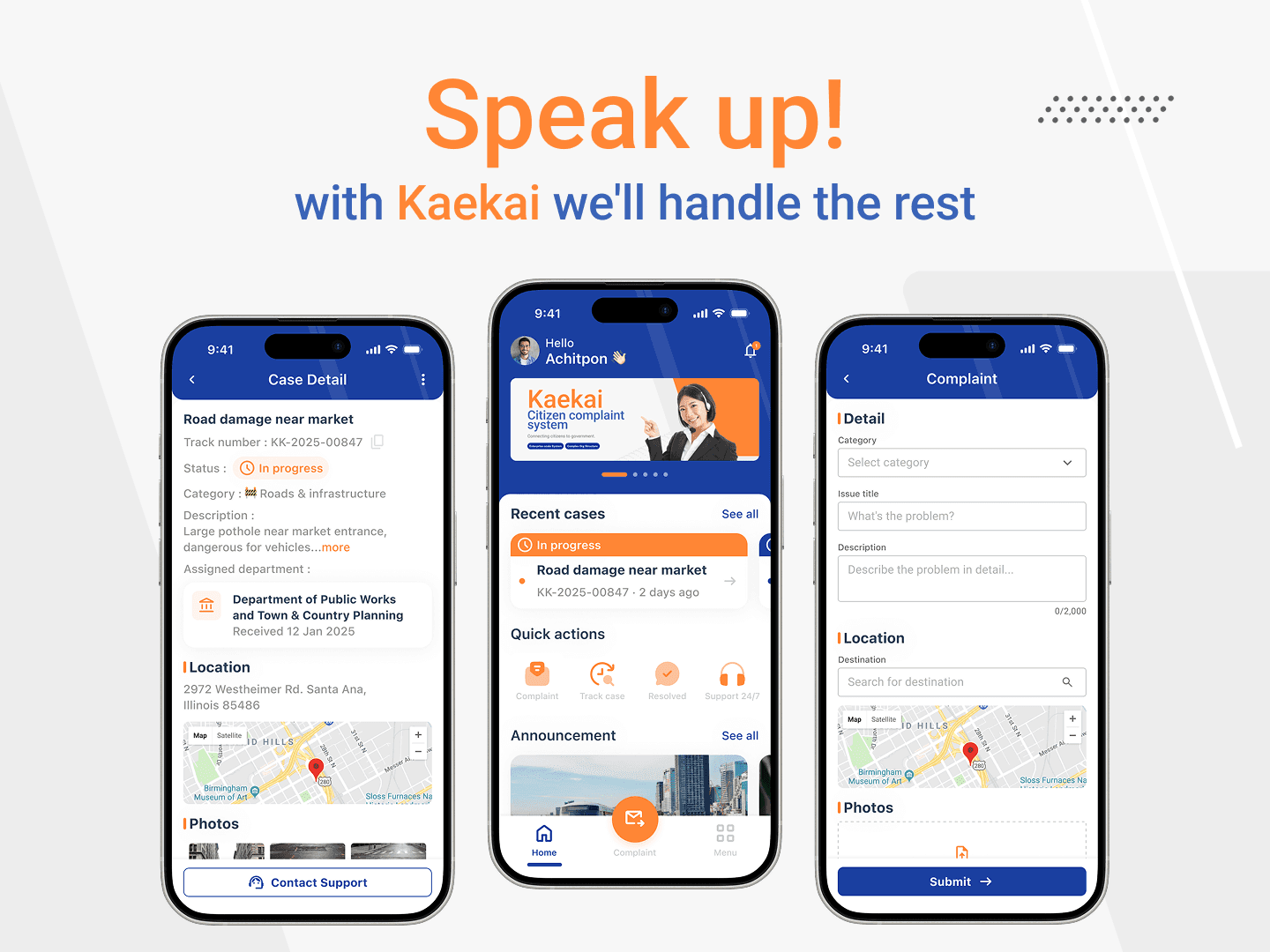
Citizens submit problems — road damage, flooding, broken streetlights — through a single mobile form with photo, GPS, and category. No need to figure out which agency to contact. The system handles that.

Central intake → smart routing
All complaints land at the central government agency first. Staff review and dispatch to the correct department through the CMS. A structured org tree ensures the right team always receives the right case.

Real-time status updates at every step
Every status change — received, routed, in progress, resolved — triggers a push notification back to the citizen. Staff can also add notes visible to the public, explaining delays or expected completion dates.
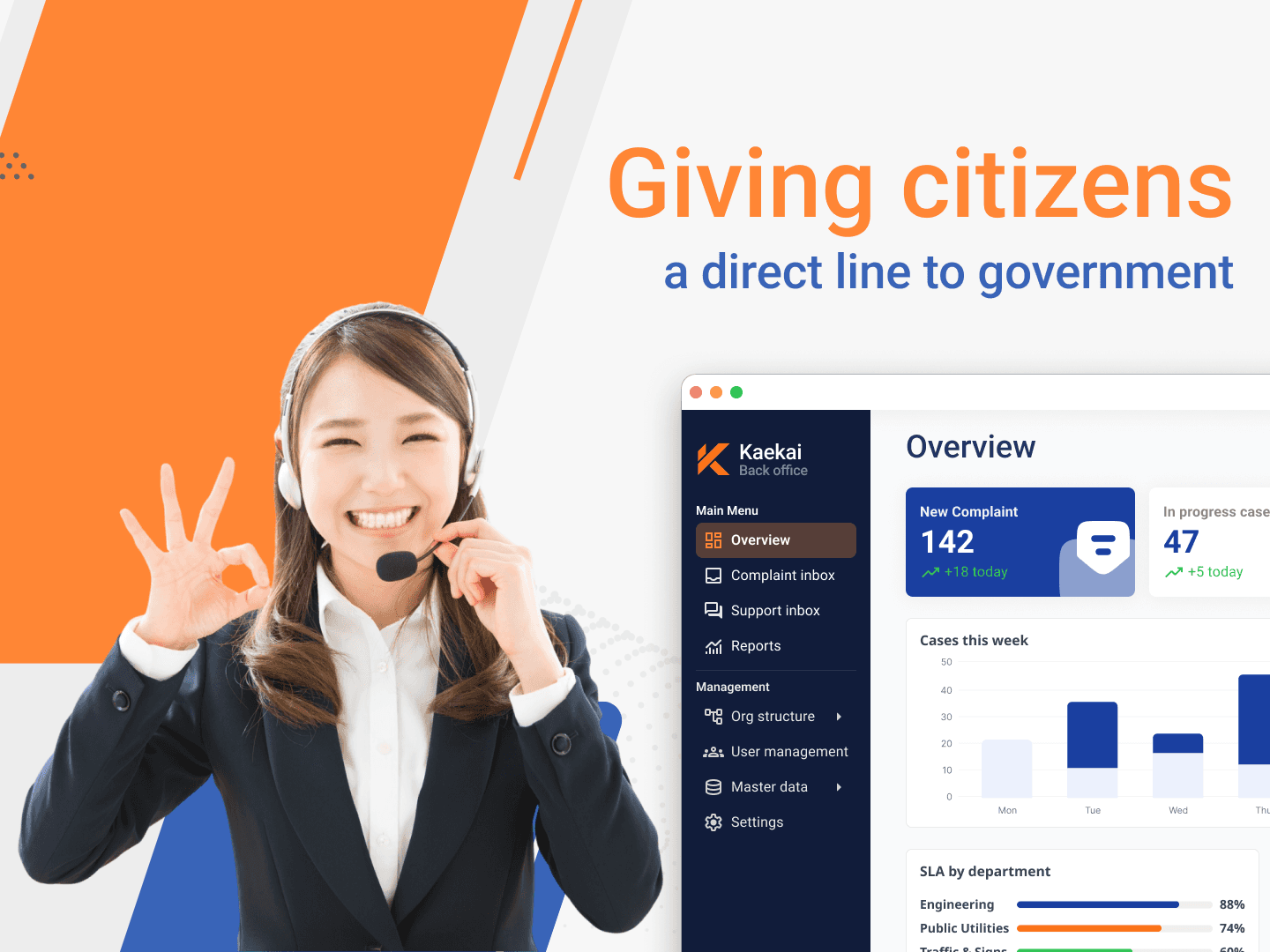
Officers see all active cases, SLA countdowns, and overdue tickets in one dashboard. Management gets aggregate reports by department, category, and resolution time — turning complaint data into operational insight.
Track your case

Guest tracking
Enter a tracking ID to view current status, assigned department, and latest officer notes — no account needed.

Logged-in history
Registered users see all past complaints in one dashboard — full timeline, officer notes, and closure record per case.
Constraints
What we were
working against
The system had to serve citizens with varying digital literacy on mobile, while simultaneously being powerful enough for government staff managing complex, multi-department workflows on desktop.
Dual audience with opposite needs
Citizens needed simplicity and clarity. Staff needed density and control. The same underlying data had to power both without compromise.
Complex org structure
Government departments are multi-level and jurisdiction-specific. The routing system had to support a deeply nested org tree without exposing that complexity to citizens.
Connectivity and device variance
Many users in target areas have low-end devices and intermittent connectivity — the mobile app had to be lightweight and work on limited data.
Key decisions & trade-offs
01
Central intake over direct departmental routing
Rather than letting citizens route their own complaints, all submissions pass through a central agency first. This ensures accountability and prevents misfiled cases but it adds a human step before dispatch.
Single point of accountability nothing falls through without a human sign-off
Adds processing time before the right department sees the case
02
Tracking without login — guest access via ID
Requiring an account to track a complaint would create a significant drop-off, especially for first-time users. Guest tracking via ID removes that barrier while still protecting full history behind authentication.
Lower barrier citizens track instantly without sign-up friction
No notification push for guests; they must actively check
03
SLA visibility surfaced to management, not just operators
SLA data is visible at both the case level (for officers) and the department aggregate level (for management). This turns individual tracking into systemic accountability making slow departments visible, not just slow tickets.
Drives systemic improvement, not just case-by-case firefighting
Requires management buy-in to act on data tooling alone isn't enough
My role
End-to-end ownership
across the full design process

Requirements
Gathering requirements from the client
Met directly with the government agency overseeing the system to clarify scope, user types, workflow rules, and technical constraints before any design work began.
Research
Understanding the problem space
Mapped citizen and staff journeys to identify where complaints were getting lost, where transparency broke down, and what staff actually needed to manage cases efficiently.

Design
Wireframes to high-fidelity UI
Designed the full citizen mobile app and staff web CMS end-to-end — including the org tree routing structure, multi-level role permissions, and all core user flows.

Presentation
Prototype walkthrough with the agency
Presented interactive prototypes directly to the government agency. Walked through both citizen and staff flows, collected structured feedback on usability and process alignment.

Iteration
Refining based on real feedback
Revised designs based on agency feedback adjusting routing logic, simplifying the complaint form, and restructuring the CMS inbox to better match how officers actually work.

Handoff
Delivering to the dev team
Prepared final designs with component specs, interaction notes, org tree logic, and edge case documentation — handed off to engineering for full implementation.
Project impact
What success
look like
Projected estimates based on design intent, civic tech benchmarks, and comparable government digitisation programmes — not post-launch measured data.
Reduction in lost cases
0%
0%
Structured routing and SLA tracking eliminate the main causes of cases going unacknowledged
Faster case routing
0×
0×
From manual forwarding (avg. 3 days) to same-day digital dispatch via CMS
Complaint access
0/7
0/7
Citizens can file and track complaints anytime not only during office hours